
A Christian Critique of the Non-Aggression Principle

Congressman Ron Paul’s breakout in the public eye during the 2008 and 2012 presidential election cycles has made limited government – or “minarchy” – a popular concept across America, especially with young people. Other politicians such as Rand Paul, Justin Amash and Thomas Massie are carrying the principles of limited government forward, with conservatives rallying behind Rand as a potential nominee for president in 2016. This libertarian stream within the GOP has been known as the tea party, the liberty movement, or simply a return to the Constitution. Call it what you will, there’s no denying its influence in the political sphere.
Riding the coattails of this movement are the anarcho-capitalists. LewRockwell.com, a self-professed anarchist blog, has become a go-to resource for anyone who wishes to see civil government restrained to any degree. The site has a mixed bag of contributors including Ron Paul and theocrat Gary North. Though anarchists and minarchists share opposing worldviews they agree on many issues and are working towards a common goal, at least for the time being. There is no inconsistency for a minarchist to partner with an anarchist to shrink the government. If anarchists want to publish our articles and promote our candidates we certainly won’t reject their assistance. But because of this close relationship, the anarchist movement has converted many to its cause. I say this based on the overwhelming amount of anarchist propaganda you’ll find on Ron Paul fansites, but perhaps I am giving them too much credit. Nevertheless, I think it is important to provide an intelligent response to their arguments, if only for the sake of Christians who are attracted to anarchy.
Anarcho-capitalists are free-market capitalists who want all tax-funded government abolished. They have it half right. Free-market capitalism certainly reflects the Bible’s teaching on economic policy. The Father, the Son and the Holy Spirit are a society of persons who voluntarily exist in relation to one another. As people made in the image of God, we exist in relation to one another and participate in the voluntary exchange of goods and services. This is the basis for free markets and free trade. Civil rulers should only intervene in the marketplace if crimes are being committed. They are never authorized to dictate artificial prices, adjust interest rates or regulate transactions between buyers and sellers.

On the other hand, anarcho-capitalists believe that civil government violates man’s freedom by its very nature and is therefore an immoral, evil institution. Anarchist icon, Murray Rothbard explains:
“The libertarian creed rests upon one central axiom: that no man or group of men may aggress against the person or property of anyone else. This may be called the ‘nonaggression axiom.’ ‘Aggression’ is defined as the initiation of the use or threat of physical violence against the person or property of anyone else. Aggression is therefore synonymous with invasion.”
“…The State habitually commits mass murder, which it calls ‘war,’ or sometimes ‘suppression of subversion’; the State engages in enslavement into its military forces, which it calls ‘conscription’; and it lives and has its being in the practice of forcible theft, which it calls ‘taxation.'” – For A New Liberty, chapter two
Rothbard is no pacifist, mind you. He does make an allowance for physical violence in response to aggression. The issue is the initiation of violence. In other words, you are free to defend yourself in a fight – just don’t start the fight. So far, the non-aggression principle (NAP) as defined is not necessarily a bad thing. The Bible certainly teaches peace and non-violence unless acting in self-defense. In this sense, all Christians should adhere to the NAP. But before we can judge if all civil government violates the NAP, we must first look at the foundation of Rothbard’s argument.
The problem is that Rothbard defends the NAP by appealing to “natural law.” Man is supposedly a blank slate who must use his sense perception and mental faculties to decide what his values will be, what his life goals will be, and how to effectively bring those goals to fruition. Man’s freedom is absolute. He is to never be forced to do anything he doesn’t want to do, even if that means freeing himself from obligations and responsibilities.
Trying to be consistent within this premise, Rothbard says that abortion and child-abandonment are valid expressions of man’s freedom. The unborn child is viewed as an aggressor, a parasite. For the mother to have an abortion is an act of self-defense. With abandonment, aggression has not been initiated against the child, the parent has simply walked away from a responsibility he did not want. If the child goes hungry or dies, the parent cannot be held accountable for inaction. In fact, if Rothbard’s view of the NAP were followed to its logical end parents would have no other option but to abort or abandon their children! Raising a child at any stage of life – feeding, cleaning, clothing, teaching, disciplining – would be violating the child’s freedom to make his own choices, his own values and his own goals.
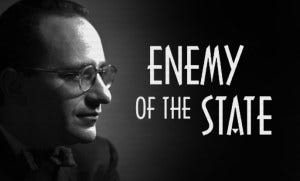
I don’t have to explain to my Christian readers that Rothbard is operating from an unbiblical view of the world, man and morality. That much is obvious. What isn’t so clear is that even within his own premise he fails to be consistent. Rothbard places an obligation on man to not initiate aggression, yet man also has the authority to exempt himself from obligations. If man’s freedom is absolute, this surely extends to his thoughts as well as his actions. On what basis can Rothbard expect humanity to accept the NAP or any of his other teachings? Once he has granted man absolute freedom he has destroyed his own argument.
Furthermore, where in “natural law” are we taught that violence is only acceptable in response to aggression? This is an arbitrary claim that is left unproven. Nature alone cannot tell people how they ought to live. Rothbard falls into the same trap atheists do when they try to base morality on societal evolution. What if I don’t care about society? What if I don’t care about nature? Aren’t I supposed to choose my own values and my own way of life? The NAP is utterly self-refuting when postulated from an unbiblical, naturalistic foundation.
Christian minarchists base their views on man being created in God’s image. We are not autonomous beings with absolute freedom. We do possess true freedom, but it is a freedom defined by the absolute authority of God. The three persons of the Trinity continually seek to glorify one another in mutual authority and submission. Since humans mirror God, each person exercises authority and submission in their own respective contexts. Parenting, for example, is a legitimate expression of authority; obedience to your parents is an expression of submission.

Likewise, God reserves the authority to execute justice upon those who violate him and therefore we have the authority to seek justice on those who violate us. But just as God has mercy upon those whom he chooses, we may also choose to be merciful to our offenders. God tells us what sins and crimes are and he gives us the proper guidelines for justice. This is rooted in a personal and loving Triune God, not some ambiguous, impersonal law of nature. The Christian faith is the only worldview that reconciles authority, submission, peace and violence without contradiction. It is only from that foundation that we may speak of the NAP coherently.
I admire Rothbard and appreciate much of his work. He has done a great job of showing the failures of statism and how society can function without a leviathan government. But do all civil governments inherently violate the non-aggression principle? Ones that are rooted in the Christian faith certainly will not.
Click for more in this series: Part 1, Part 2, Part 3, Part 4, Part 5
<>продвижение ов по ключевым запросам
The post A Christian Critique of the Non-Aggression Principle appeared first on Kuyperian Commentary.