
Psalm 2: Yahweh’s King

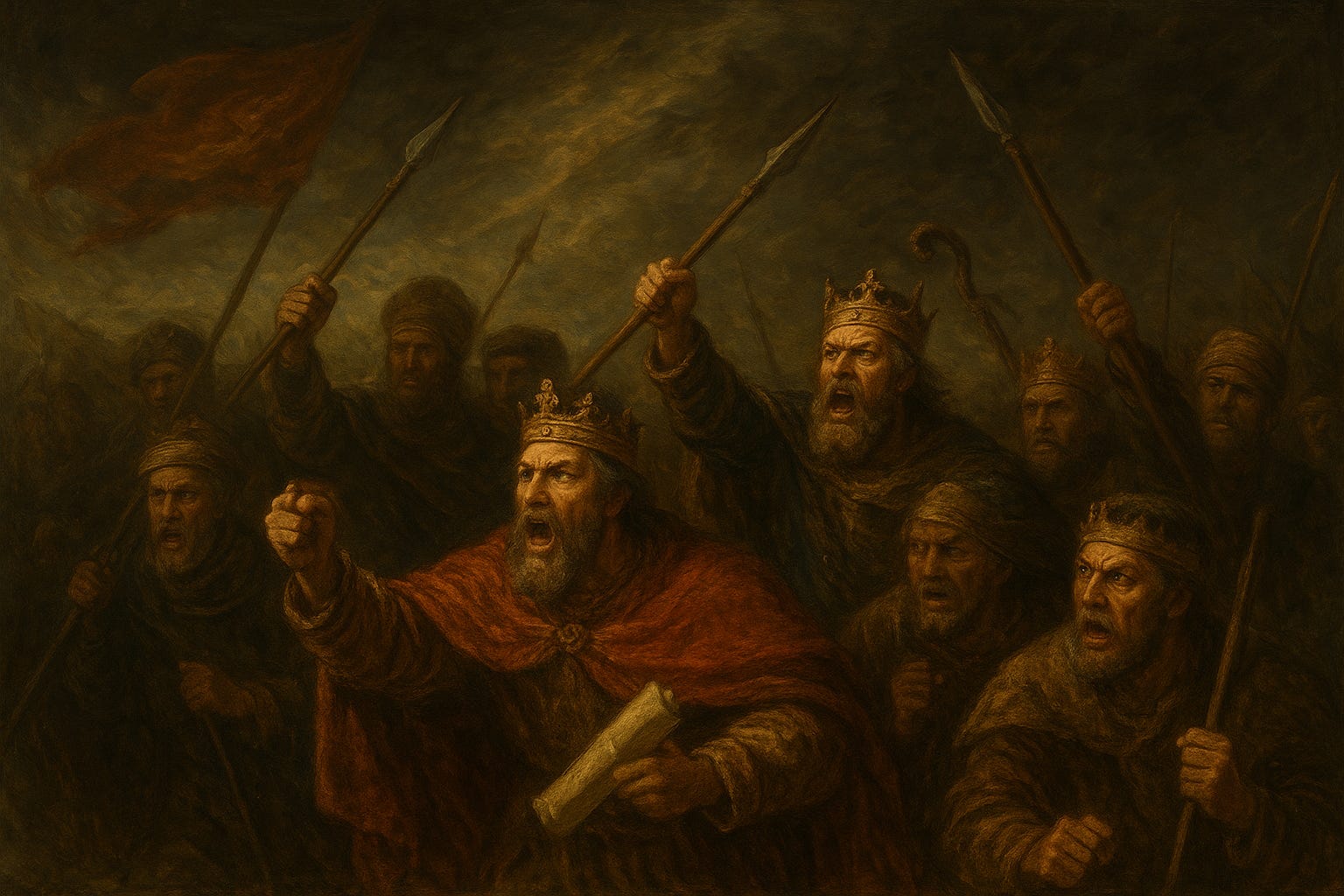
The Psalms are a book of conflict reflecting the war between the wise and the wicked, a reality set up in Psalm 1. The conflicts run deep and broad. Wars are raging at every level of our existence. We have wars within ourselves, wars among God’s covenant people, and wars with those who are declared enemies against God.
Conflict abounds. At this stage of Scriptural history, this is no surprise. Immediately following the fall in God’s visit with the man, woman, and serpent, the conflict was established. God restored man to a right relationship with himself and, therefore, to his original relationship with creation. Man was still called to take dominion over the creation.
Man’s mission to take dominion remained the same as before the fall. Adam’s mission was to establish a kingdom. Adam, God’s son (Lk 3:38), was the prince-who-would-become-king over creation as he made the world fruitful and ordered it so that God’s will was done on earth as it was in heaven. The man was created immature (even though his body was that of a grown man). He was destined for a great kingship. Adam, however, handed his position over to the serpent.
God’s restoration of man after the fall was God’s gracious redemption. However, the effects of sin could not be avoided. Man’s dominion project would be arduous as he faced the thorns and thistles of the ground and an enemy whose purpose was diametrically opposed to God’s plan for his creation. The serpent and his seed were enemies of God who would fight man in the unseen realm of principalities and powers, as well as through those sons of Adam who pledged their fealty to the serpent and his mission.
God restored Adam’s relationship to him and with creation, setting him back on track, but it would take another Adam to complete the mission. Through the centuries, God raised up new Adams in types and shadows, anticipating the final Adam (Rom 5:12-20). Noah, Abraham, Isaac, Jacob, Joseph, Moses, Israel, and, eventually, Israel’s king, David and his sons all took up the Adamic vocation. As God appointed them new Adams, they took up the responsibilities of Adam’s mission and the enmity that came with it. The context of Psalm 2 is this enmity. The prophecy of Psalm 2 is victory, a renewal of the promise for the seed of the woman to crush the head of the seed of the serpent.
Psalms 1 and 2 are often paired together as the introduction to the Psalter. Psalm 1 sets up the contrast between the wise and the wicked, the enmity, and Psalm 2 shows how the wise one becomes king. Those who follow the path of wisdom submit to God’s Messiah, his Anointed One or “Christ.”
Psalm 2 is a promise to the son of David, the king of Israel, that he will rule the world, establishing God’s order in fulfillment of God’s implicit promise in his command and blessing concerning dominion in Genesis 1. This is the promise for the whole world to be arranged under the lordship of God’s son. This is the kingdom of God.
Psalm 2 provides the foundation for all the prayers, instruction, comfort, and encouragements throughout the rest of the Psalter. For all those times of distress when the world is in chaos and God’s faithful are being persecuted and crying out, “Where is David’s son to set things right?” Psalm 2 is the refuge of promise of certain victory.
The Psalm is divided into four stanzas: stanza one, verses 1-3; stanza two, verses 4-6; stanza three, verses 7-9; and stanza four, verses 10-12.
The opening stanza asks why the nations are raging and fighting against Yahweh and his Messiah. God’s enemies are restless and chafing under his rule. In vain, they plot or murmur against Yahweh and his Anointed One. In contrast to the wise man who “murmurs” God’s law day and night, the wicked are murmuring against Yahweh. Everyone is murmuring. Either you are meditating on God’s law in love for God, or you are murmuring against him. What you murmur is the difference between being wise or wicked.
The wicked consider God’s law bondage. They are constrained and want to be freed. They believe God is holding them back from their true purpose and what is best for them. They crave liberty from God’s law. They don’t understand God’s law as guardrails set up in his love to keep us from careening off the cliff. They believe that they are chains and cords that keep them bound from discovering their authentic selves and shaping the world into a utopia.
Yahweh responds with laughter and anger. The one who sits in the highest place of authority–the heavens–laughs and holds them in derision. God’s laughter is the laughter of one in complete control who determines the outcome of all things, observing the arrogant efforts of a puny enemy to resist his will. God’s laughter is the laughter of watching the evil man think he has everything figured out and has the upper hand, only to have the tables suddenly turned on him. His plans are foiled, and, with the turn of events, he is laughed at because he receives justice.
Yahweh’s laughter is a mocking laughter that is filled with wrath. The raging nations with their kings are attacking the creation he loves by trying to throw off the bonds of his law. They are bringing chaos and destruction where there should be order and deliverance. As they set themselves against all that God loves, God sets himself in anger against them. He will destroy anyone who tries to destroy what and who he loves.
The kings of the earth are usurpers, trying to establish their wicked rule on the earth. Yahweh will not allow it. He speaks, making the decree to David’s son, “You are my son, today I have begotten you.” (Psalm 89 will recount more of the details of this covenant.) 2 Samuel 7 and 1 Chronicles 17 recount the history of God making a covenant with David. God promised that David’s son would be his own son (2 Sam 7:14). Yahweh’s promise to his son is that if but asks, Yahweh will give him the nations for his inheritance. This promise reaches back through Abraham being promised that through him all the nations of the earth would be blessed (Gen 12:1-3) to Genesis 3 with the promise to the seed of the woman being victorious over the seed of the serpent. David’s son will not merely reign over a little plot of ground on the shores of the Mediterranean. He will reign over the whole earth. Yahweh’s son will establish his kingdom by breaking the kings and their nations with a rod of iron and dashing them in pieces like a potter’s vessel. Resistance is futile. The cosmos will be under the rule of God’s son.
The Psalm ends with a call to the kings of the earth to be wise. The way of wisdom is to submit to Yahweh’s Messiah, the son of David. Kings are not only to bring themselves under submission to the king, they are to bring their dominions, their nations, under the rule of the Messiah, pledging their allegiance to him with a kiss. Those who do this will find refuge and will be blessed, as the wise man is promised in Psalm 1. Those who do not will find an angry son who will destroy them.
The promise of God establishes the foundation for all the church’s prayers. We live, love, and work in the hope that Christ Jesus will establish his order on earth. In the midst of all our troubles, we pray with this promise on our lips and this hope in our hearts. Ours is to walk by faith, living according to the reality that our God has established his king with all authority in heaven and earth through his death, resurrection, and ascension. The resistance efforts of all those who mock him and seek to break the bonds of his rule will end in futility.
The post Psalm 2: Yahweh’s King appeared first on Kuyperian Commentary.