
The Grace of Childermas

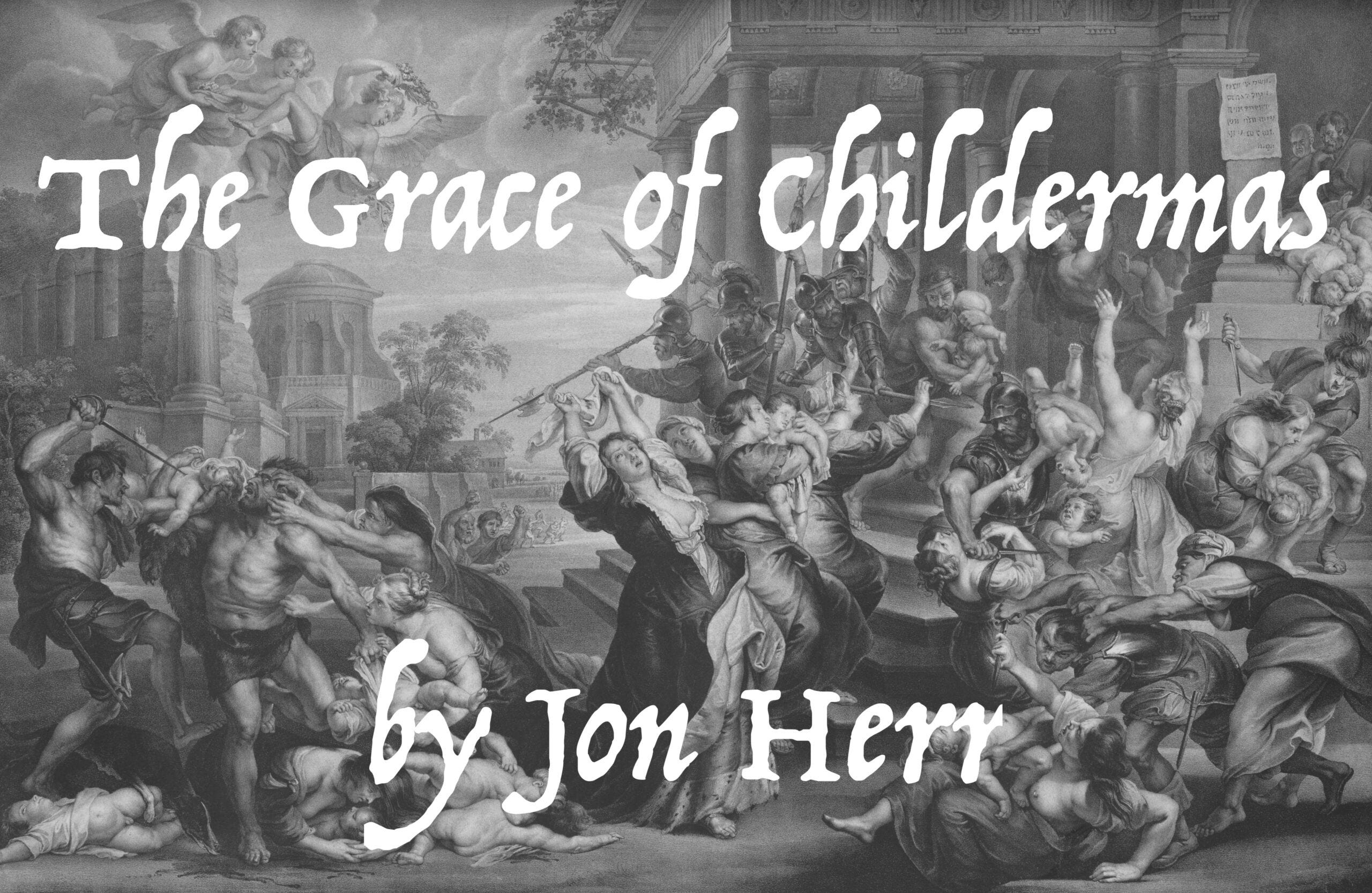
December 28th, the 4th Day of Christmas, has—since at least the 400s AD—been observed as the “Feast of Holy Innocents.” Or, in England, “Childermas.” It has been a feast day based on the words of the Gospel, from Matthew 2, of Herod killing “all the male children in Bethlehem and in all that region who were two years old or under.” (Mt 2:16)
St. Matthew is—perhaps mercifully—sparing on the details, but imagine the terror of Bethlehem that day, as the streets which were ordinarily full of people going about their daily routines, were suddenly filled with Herodian soldiers. Soldiers who perhaps went house-to-house, kicking doors in, finding nursing mothers, ripping their child from them, and killing the little one.
We don’t want to think about that. Yet it happened.
We can dull the effect and the pain of the event by putting on academic airs, and perhaps a distinguished English accent, and saying, “Well, you see, this is a clever callback to Pharoah who also had male Hebrew babies put to death in Exodus 1 & 2, don’t you know.” That usually “settles things” for us, and we can go back to reading in Matthew 2 about Jesus, and how He and His Family fled to Egypt, then came back and settled in Nazareth. Christmas joy is saved.
But why was this episode necessary? Surely God could have skipped it entirely. Herod could have gone on a manhunt to find Jesus without spilling any other blood, right?
He didn’t. In God’s sovereign and providential plan, a number of Bethlehemite babies were killed, in a spiteful and proud attempt on Jesus’s life. It’s uncomfortable. And if reading about it in the Scriptures isn’t bad enough, why have Christians for centuries spent a whole day during their Christmas celebrations, to focus on this storyof all things?
Can’t we celebrate Jesus’s birth, and open our presents, and sip our cocoa, and be festive without thinking about Herod going on a murderous rampage and killing innocent little babies? Christmas is a celebration of the coming of the Light of the World, into the world, why wallow in such darkness?
I think the Church has been on to something here. And I hope you will come to see it too, as you read on below, and see this event in Matthew 2 in a new light. I hope you will not just read past it quickly any more, but pause, and stare it in the face.
We don’t want to think about grief in the midst of a joyful season. But there’s a reason for it. God chose to include it in history, and in the pages of Scripture, and the Church has sought to take that seriously. So should we. And so I’m going to tell the story.
The Origin of Childermas
Most of you have not spent much time thinking about Childermas. You probably have not spent much time thinking of Herod’s rampage. Perhaps, however, you have attended a traditional “Lessons and Carols” service and heard a choir sing the “Coventry Carol.” It is a carol written in the 1500s, about this event.
“Herod the king, in his raging,
Chargèd he hath this day
His men of might in his own sight
All young children to slay.”
Old as it is, this carol is still quite famous. It has been covered by John Denver, Pentatonix, and Mannheim Steamroller—but I would bet good money you’ve never heard it on any regular radio station in December! Again, because we modern people don’t know what to do with this terrible story.
I am not aware of any Christmas carols written on this in modern times, but the Coventry Carol is far from the only old one. Another from the 1500s goes thus:
“Herod that was both wild and wode,
Full much he shed of Christian blood,
To slay the Child so meek of mood,
That Mary bare, that clean may.
Herod slew with pride and sin,
Thousands of two year and within;
The body of Christ he thought to win
And to destroy the Christian fay.”a
Another from the 1400s:
“King Herod then in his great wrath
Seeing of them his purpose lorn
Infants full young he put to death
Through all Bethlehem, that there were born.
This star that day then went away
From that sweet place where Jesus lay.”b
The Venerable Bede put this to verse wonderfully in the 700s:
“By that accursed monarch slain,
Their loving Maker bade them reign
With Him they dwell, no more distressed,
In the fair Land of light and rest:
He gives them mansions, one and all,
In that His Heavenly Father’s Hall:
—Thus have they changed their loss for gain,
By that accursed Monarch slain.”c
One of the earliest Christian hymnists, called Prudentius, also wrote a hymn about this around AD 400. It has been translated numerous times, but one translation goes:
“Hail, infant martyrs, new-born victims, hail!
Hail, earliest flowerets of the Christian spring!
O’er whom, like rosebuds scattered by the gale,
The cruel sword such havoc dared to fling.
The Lord’s first votive offerings of blood.
First tender lambs upon the altar laid.
Around in fearless innocence they stood.
And sported gaily with the murderous blade.”d
Why was there so much focus on this? Why were so many carols written about it? Maybe you caught the hint in that last hymn: the Church has always viewed these babies Herod killed, as the first Christian martyrs. Not a recognition that gets much play today, but never disputed.
And so, since virtually the beginning of the December 25 celebration of the Nativity—at least as early as AD 484,e three more feast days were observed: the feast of St Stephen on December 26, the feast of St. John on December 27, and the feast of Holy Innocents on December 28. These three—Stephen, John, and the Innocents—were placed together, to remind us of one of the key reasons Jesus was born: He was born to die. And as a result, those who follow Him, are also called to die with Him.
Each of these three did so in different ways. Stephen went willingly, and actually died. John the Evangelist would have gone willingly, but didn’t actually die for the faith. And the Holy Innocents in Bethlehem didn’t go willingly, but they actually died. These three illustrate various ways martyrs can be made. Those who would be “Companions of Christ” follow Him to death. There’s no “one-size-fits-all” way to do so. And these 2nd, 3rd, and 4th days of Christmas remind us of just that.
These baby boys of Bethlehem lost their lives for Christ, though they didn’t ask for it, or understand what was going on, and no one watching could have said they deserve it. They would seem to just be “unlucky collateral damage,” but Bernard of Clairveux said this shows that “there should be peace for men in the sacrament of mercy even without the co-operation of their own will.”f
This is the “Grace of Childermas”: that Christ can and does save even babies who die in infancy.
The Reality of the Innocents’ Innocence
But if this answers the question of why anyone would observe this day, it would seem to raise more questions further than it answers. One perhaps in particular: You’ve claimed that these babies were martyrs—that they were “saved”—but you haven’t proved it! Matthew 2 doesn’t tell us anything about them, other than that they died! Aren’t we being a little bit “extra-biblical” here, to call them “Christian martyrs”?
This is an important question. Matthew 2 does not ask this question, nor does the Bible answer it directly. And yet, difficult passages of Scripture are meant to be wrestled with. Let’s do that, briefly surveying Matthew 2:13-18.
Verse 13 comes after the Magi have come to worship Jesus, and brought Him gifts of Gold, Frankincense, and Myrrh. Verse 13 tells us that after the Magi left and went home, Joseph was told in a dream to flee to Egypt, because Herod was out for the Child’s life.
Now, since we’re thinking about the eternal destiny of the “Holy Innocents” in Bethlehem, it might be worth asking: were the Magi “redeemed”? That may seem like a dumb question, because Matthew 2:11 tells us “they fell down and worshiped him.” So of course they were, we’d think.
But just to be honest about it, the Bible doesn’t actually tell us. For all we know, the Magi had a great “spiritual” experience, and then went back to their home in the East, and returned to being heathen Zoroastrians. Or whatever. Here’s the point: we have every reason to believe the Magi were converted. But believing that doesn’t come from an explicit biblical statement. I think we ought to keep that in mind as we think about the babies in Bethlehem.
In any case, Joseph takes Mary and Jesus to Egypt, in order to save them from Herod’s wrath. And we’re told that this fulfills Hosea’s prophecy that “out of Egypt I called my son.” Here are the Exodus themes, of course. Herod is acting like Pharoah in Exodus; Israel has become like Egypt; and Joseph is like a new Moses leading “God’s Son” (Ex 4:22) out to safety. Jesus is “the personification or embodiment of true, obedient Israel. If God could call Israel his ‘first-born son,’ . . . how much more Messiah Jesus.”g
Important as all of this biblical symbolism and typology is, we should not breeze past the reality of the event. So here is a question: Did Joseph tell anyone in Bethlehem that he was leaving, or where they were going? Surely, as his ancestral home town, he had relatives there. Surely he knew people there. Surely he knew someone who had a 2-year-old son. Did he warn them? Or even if he didn’t know someone personally, did he tell someone he knew to warn them? And did they?
St. Matthew says that at the coming of the Magi, Herod “was troubled, and all Jerusalem with him.” (2:3) The coming of these wise men was not some big secret—it had caused something of a stir! And close as Bethlehem was to Jerusalem, you can imagine that if Joseph had warned someone else—“Hey, Herod is coming to kill my son, you might be in danger, too!”—they would have had at least some context to think about their danger! Now, the angel only tells Joseph that Herod was going to seek Jesus’s life. Perhaps he, being a just man, would not have even thought about what evil Herod was capable of.
The Bible doesn’t say. So we should avoid getting caught up on questions with no answers. But at least let the story be alive to you.
So to verse 16. Though it is terrible, and horrible, and not very “festive” to think about, inspired Scripture says: Herod
“sent and killed all the male children in Bethlehem and in all that region who were two years old or under.”
It may not be comfortable to think about the Israelites under Joshua going on a conquest of the Promised Land, and destroying whole cities of men, women, and children. But at least God was clear about why: the wickedness and idolatry of the Canaanites was great, and deserved judgment. We may not like it, but it’s so.
But here? What did these babies ever do except—through no fault of their own—have an “unlucky birthday”? Why did God let this happen?
Let’s think about the two chief “characters” here: The Irate (Herod) and The Innocent (the babies).
Herod had expected news from the Magi—a street address for this so-called child born to be the King of the Jews—and when they went AWOL, he realized they had tricked him. They had played him for a fool. And verse 16 says he was “furious.” This proud tyrant got irate, and would not stand for this. All he could think of was blood. Someone had to be punished, and it did not matter how many would have to die, if only he could manage to get that one baby out of the picture! St. Matthew gives us no indication of any scheming or planning, just brute force and action.
He was not irate only because he was duped, however. This is a guy who killed his own sons because he thought they might steal his crown. This is a guy who killed a big group of Pharisees and their followers, because they had predicted he would lose his throne. All this guy cared about was making sure he stayed king. Any sniff of royal hopefuls, or crown challengers, and he would go mad.
And now, some aristocrats from far away had traveled many miles to find a baby king. And the stars in the night sky had been a little bit suspicious lately, doing some dodgy things, so you better believe he would do whatever he had to, to protect his rule.
Here, then, is another hint at the point of all of this; the point of Childermas. We hear people talking about how they like the “little baby Jesus,” but maybe not so much the grown-up one. Christmas is nice and merry because, well, who wouldn’t love a sweet little baby in a manger (no crying He makes)?
Everyone can get behind that kind of Christmas these days. That kind of Christmas is just about a baby in poverty, who had to become a refugee, and teaches us that we should all just get along with people who are different than us. That’s what we hear these days.
But if you think that is what Christmas is about, the Feast of Holy Innocents would like a word with you. Christmas—from its very first moments—is about a baby born to be King. One who was born to “destroy every rule and every authority and power.” (1 Cor 15:24) One who was born to gain “all authority in heaven and on earth.” (Mt 28) One who was born in Bethlehem because He was David’s son, and therefore the one who would ask, and God “would make the nations His heritage, and the ends of the earth His possession.” (Ps 2:8) One whom kings need to kiss lest God be angry and they perish in the way. (Ps 2:12)
You see, Herod had it right, but only in part. Christmas meant something way worse than Herod losing his throne. It means that every human ruler is in danger of a dethroning! Jesus was not just a threat to King Herod…but to every king.
The Child born in Bethlehem is coming for every tyrant who would kill babies.
Christmas is certainly about hope, peace, joy, and love. But only through Christ. Only through His Cross and Resurrection, and now His Reign as King. If you think Christmas is just about a sweet little serene baby, you are not taking Matthew 2:16 seriously. And if you think following the Christ Child is just a matter of being “meek and mild,” this verse should also shake you awake. Because the truth is, if you get mixed up with the Child born in Bethlehem, there will be those who hate Him, and see you as part of the problem. That’s why there were martyrs right from the beginning of Christmas, and why there continue to be: because Christ is a threat to the pride of the hearts of sinful men.
So that’s Herod, The Irate. What should we make of the children, The Innocents?
As quickly as they enter the story, they’re gone from it. I have been calling them “martyrs,” now it’s time to back that up. First I want to demonstrate that this is—with no exception I am aware of—the universal belief of the early Church.
Irenaeus said that Jesus,
“since He was Himself an infant, so [arranged] it that human infants should be martyrs, slain, according to the Scriptures, for the sake of Christ.”h
Cyprian said,
“The nativity of Christ witnessed at once the martyrdom of infants, so that they who were two years old and under were slain for His name’s sake. An age not yet fitted for the battle appeared fit for the crown.”i
Ambrose said that these
“received the palm of victory before they felt their natural life within them.”j
Augustine said that Herod here sought to persecute Christ, and in the process
“furnished an army (of martyrs) clothed in white robes, of the same age as the Lord.”k
Caesarius of Arles said,
“Rightly are they called the ‘blossoms of martyrdom,’ since a kind of frost of persecution, along with cold unbelief, consumed them in their very beginning, like the first emerging buds of the Church. For this reason it is proper to give ceremonial honor to the infants who were killed for Christ’s sake, not to grieve over them; . . . because the one who was the source of their being hated was also the reason for their crown.”l
Peter Chrysologus asks why Christ would abandon these innocent children?
“Brethren, Christ did not contemn his soldiers; He promoted them. He enabled them to triumph before living.”m
This was the universal belief of Christians from the beginning, and Luther agreed: “Admittedly they could not speak or understand. Yet they were holy and blessed.”n But Calvin does not mention it that I can find, and the Reformers and theologians since, have gone virtually silent. I am sure that some agreed, but this affirmation—which was everywhere—has gotten lost in recent centuries.
The great puritan, Matthew Henry, is a notable exception to this silence:
“They shed their blood for him, who afterwards shed his for them. These were the infantry of the noble army of martyrs. If these infants were thus baptized with blood, though it were their own, into the church triumphant, it could not be said but that, with what they got in heaven, they were abundantly recompensed for what they lost on earth.”o
But the question remains: is this an extra-biblical idea? We call them “Innocent,” by which we mean they had not deserved death in this instance. Surely they carried the guilt of Adam, as we all do, but they did nothing to Herod!
Here is, I think most simply, the reason this is viewed as a martyrdom, and these baby boys viewed as redeemed and crowned: they died for Christ. This was not a death aimed at them for something they did, it was aimed at Christ. They were not just the unfortunate collateral of war, or famine, or starvation. And I am not saying that dying before an “age of accountability” is the reason these were redeemed. No, the reason is that they were killed by Herod because Herod was trying to kill Christ. And that is what martyrdom is: it is the world’s attempt to put down Christ. It is why Christ asked Saul on the Damascus road, “Why are you persecuting me?” Martyrdom is dying for Christ. And that is what happened to these babies in Bethlehem.
I have been saying that the Bible does not tell us about the eternal status of these infants, and that is true. The basic logic here is that Christ would certainly not allow those who died for Him to be eternally lost. But there are still important biblical clues in the text.
Matthew 2, verses 17 and 18, say:
“Then was fulfilled what was spoken by the prophet Jeremiah: ‘A voice was heard in Ramah, weeping and loud lamentation, Rachel weeping for her children; she refused to be comforted, because they are no more.’”
This is quoted from Jeremiah 31. And there is a lot going on here, but the first thing to notice is that these infants were killed to fulfill Scripture. Is God the kind of God who would nonchalantly let them die for Jesus and be lost? Is He that kind of cavalier? We believe in a God who is perfect and good. A God who is just and righteous. A God who sovereignly works “all things according to the counsel of His will.” (Eph 1) And so He must have had a purpose in this. This is what the Church Fathers were picking up on: God’s purpose was to promote these infants to fullness of life in Heaven, even before they had a chance to live a full life on Earth!
The second thing to notice is that in this quotation from Jeremiah, these Innocents are called “Rachel’s children.” As Rachel was the wife of the patriarch Jacob, and her children were the fathers of the Twelve Tribes of Israel, this points to these infants being “sons of the Kingdom.” These belonged to Christ, and were redeemed even in death, by God’s mysterious providence.
But there’s still more. “Rachel weeping for her children”is picking up on Genesis 35, where Rachel died giving birth to Benjamin, and was buried on the way to Bethlehem. So the pain and sadness of her final hours became associated with Bethlehem.p By pointing to this event, however, Jeremiah was on to something else. When Jeremiah said, “A voice was heard in Ramah…Rachel weeping for her children,” he was speaking of Israel’s exile to Babylon. The captives were rounded up in Ramah, and marched into exile from there. (Jer 40:1) St. Matthew certainly was thinking of the same things here—the exile of Israel in the days of Jeremiah—as he was also thinking about Christ’s own “exile” to Egypt.
This is the third thread of evidence, then: Matthew quotes from Jeremiah 31, but as one writer says, he “reproduces the only gloomy verse in all of Jeremiah 31”!q Matthew quotes Jeremiah talking about “Rachel weeping for her children”because they will go into exile, knowing full well that all of the surrounding verses promise restoration and salvation!
Here are just a few of the verses around it:
Jeremiah 31, verses 3 & 4: “I have loved you with an everlasting love; therefore I have continued my faithfulness to you. Again I will build you, and you shall be built, O virgin Israel!”
Verses 8 & 9 say that Israel’s remnant “shall return here. With weeping they shall come, and with pleas for mercy I will lead them back…for I am a father to Israel, and Ephraim is my firstborn.”
And right after the verse about Rachel weeping for her children, verses 16 & 17 say:
“Keep your voice from weeping, and your eyes from tears, for there is a reward for your work, declares the Lord, and they shall come back from the land of the enemy. There is hope for your future, declares the Lord, and your children shall come back to their own country.”
The children Rachel wept for in Jeremiah, who went into exile, would be redeemed. So if this is fulfilled in Matthew 2, we have more than a heavy indication that the weeping in Bethlehem over the infants Herod killed, should instead be met with hope, for these babies, dying for Christ, were among the firstfruits of His Church. They were among the firstfruits of those He would return from Egypt to redeem.
We know well how Christ spoke of little children. “Let the little children come to me and do not hinder them, for to such belongs the kingdom of heaven.” (Mt 19:14) “Truly, I say to you, unless you turn and become like children, you will never enter the kingdom of heaven. Whoever humbles himself like this child is the greatest in the kingdom of heaven.” (Mt 18:3-4) “Truly, I say to you, whoever does not receive the kingdom of God like a child shall not enter it.” (Lk 18:17)r
This being true, does it not follow that “receiving the kingdom of God like a child” includes not only living like a child, but also dying like one? Does it not follow that the Innocents of Bethlehem received the kingdom even their death?
So yes. I stand with the whole history of Christendom in calling them martyrs.
Having argued this, however, what then?
What Childermas Means for You
What is the point of Childermas, during Christmas? First, all of this points ahead to the Cross. Herod sought Christ’s life, so Joseph took Mary and Jesus to Egypt “by night,”Matthew 2:14 says. He was spared then, but by Matthew 26, when a different sort of tyrant seeks Christ’s life, they arrest Him in Gethsemane “by night.” Here in Matthew 2:16, Herod realizes he was “tricked,” and the Greek word means literally “mocked.” This word is only found in Matthew here, and in the Passion narrative when Jesus is mocked. (Mt 20:19; 27:29-31, 41) Here in Matthew 2, Jesus is saved from death at the hands of a raging and irate King, by descending into Egypt, and ascending back again; and other babies die for Him. By the end of His earthly life, Jesus is killed on the Cross, but was “saved from death” (Heb 5:7) through a descent to the dead, and a resurrection back out of death; and His apostles and followers die for Him.
Herod tried to kill Jesus, because he could not abide the thought of there being another king. When the Jews brought Jesus before Pilate, to have Him killed, it was because they couldn’t abide the thought of Him as king. “We have no king but Caesar,” they said. (Jn 19:15)
All that happens here in Matthew 2 is—in miniature—what would happen later, for us and for our redemption. And so, the Holy Innocents are also—in miniature—a Christmas call to us, that we would have our lives “mixed up with Christ,” so that when worldly tyrants seek Christ’s death, we would be caught in the crossfire. It is a call to us that we would—by faith in Him—“be blameless and innocent, children of God without blemish in the midst of a crooked and twisted generation, among whom [we] shine as lights in the world.” (Phil 2:15)
So why would we want to think of this horrible massacre at Christmastime? God saw fit to record it in the pages of Scripture as a reminder to us, in the midst of Christmas, to oppose kings who resist Christ as King, even if it means our death.
The “grace of Childermas” is that in all of our griefs, struggles, persecution, and even our death, as we follow the King born in Bethlehem, His resurrection and reign mean that we are forgiven, washed, cleansed, and will reign with Him. (2 Tim 2:12)
And does not the “spirit of Herod” still seek blood today?
CS Lewis preached a Christmas sermon in 1946 in which he said that modern, post-Christian people are seeking to overcome nature. Rejecting Christ, we have come to view the world as a meaningless set of evolutionary processes, and we just need to control it for ourselves. And yet, he says, in doing so,
“Man’s conquest of Nature is really Man’s conquest of Man. . . . Men are the victims, not the conquerors in this struggle: each new victory “over Nature” yields new means of propaganda to enslave them, new weapons to kill them, new power for the State and new weakness for the citizen, new contraceptives to keep men from being born at all.”s
Indeed, like Herod, rejecting Christ means we will kill anyone who would knock us off the thrones of our pride, anyone who would get in the way of our own comfort. So it’s no wonder at all that abortion is so fiercely protected.
Like Herod, modern peoples do not want a little baby “reigning” over them, or want the needs of a child overruling their own pursuits. As someone put it, abortion objectively means this: “I, the adult with power over life and death, will have no ruler but myself alone…I will not serve, I will not show mercy. This child is a nuisance, an inconvenience, a hardship, it will change the way we have to live our lives, and that, finally, is what we cannot allow.”t
That is the “spirit of Herod,” and that is exactly what Childermas—and Christmas—opposes with every fiber of its being. Therefore be warned, oh kings. Be warned, America. We must cease our Herodian infant massacre, and embrace the one born to be King.
The killing of the Holy Innocents is just such a warning. But it is also for our hope. Christ was born to bear our griefs and carry our sorrows. He was born to take upon Himself the chastisement that brings us peace. He was born to take wounds by which we are healed. (Is 53)
Even as His birth brought grief to many families in Bethlehem, so our peace with God now does not mean our griefs are immediately taken from us. But His birth meant that they would not be meaningless, and that in conquering the world, King Jesus would finally set all things right.
So, Merry Christmas. And Merry Childermas. Let earth receive her king.
Photo by The New York Public Library on Unsplash
William Sandys, Christmas Carols Ancient and Modern (London: Richard Beckley, 1833), 18. (back)
Stephan Waetzoldt and Julius Zupitza, Archiv für das Studium der neueren Sprachen und Literaturen (Braunschweig: George Westermann, 1892), 228. (back)
John Mason Neale, ed., Mediæval Hymns and Sequences (London: Joseph Masters, 1851), 15-16. (back)
John Chandler, The Hymns of the Primitive Church (London: John Parker, 1837), 52. (back)
William E. Addis and Thomas Arnold, A Catholic Dictionary (New York: The Catholic Publication Society Co., 1887), 445. (back)
A Priest of Mount Melleray, trans., St. Bernard’s Sermons for the Seasons & Principal Festivals of the Year, vol. 1(Westminster, MD: Carroll Press, 1950), 420. (back)
W. D. Davies and Dale C. Allison Jr., A Critical and Exegetical Commentary on the Gospel according to Saint Matthew, vol. 1, International Critical Commentary (London; New York: T&T Clark International, 2004), 263–264. (back)
Irenaeus of Lyons, “Irenæus against Heresies,” in The Apostolic Fathers with Justin Martyr and Irenaeus, ed. Alexander Roberts, James Donaldson, and A. Cleveland Coxe, vol. 1, The Ante-Nicene Fathers (Buffalo, NY: Christian Literature Company, 1885), 442. (back)
Cyprian of Carthage, “The Epistles of Cyprian,” in Fathers of the Third Century: Hippolytus, Cyprian, Novatian, Appendix, ed. Alexander Roberts, James Donaldson, and A. Cleveland Coxe, trans. Robert Ernest Wallis, vol. 5, The Ante-Nicene Fathers (Buffalo, NY: Christian Literature Company, 1886), 349. (back)
Ambrose of Milan, “On the Duties of the Clergy,” in St. Ambrose: Select Works and Letters, ed. Philip Schaff and Henry Wace, trans. H. de Romestin, E. de Romestin, and H. T. F. Duckworth, vol. 10, A Select Library of the Nicene and Post-Nicene Fathers of the Christian Church, Second Series (New York: Christian Literature Company, 1896), 35. (back)
Thomas Aquinas, Catena Aurea: Commentary on the Four Gospels, Collected out of the Works of the Fathers: St. Matthew, ed. John Henry Newman, vol. 1 (Oxford: John Henry Parker, 1841), 82. (back)
Caesarius of Arles, “Sermons,” in The Fathers of the Church, vol. 66 (Washington, DC: The Catholic University of America Press, 1973), 140. (back)
Peter Chrysologus, “Saint Peter Chrysologus: Selected Sermons, and Valerian: Homilies” in The Fathers of the Church, vol. 17 (New York: Fathers of the Church, Inc., 1953), 257. (back)
Martin Luther, Martin Luther’s Basic Theological Writings, ed. William R. Russell and Timothy F. Lull, Third Edition (Minneapolis, MN: Fortress Press, 2012), 248. (back)
Matthew Henry, Matthew Henry’s Commentary on the Whole Bible: Complete and Unabridged in One Volume (Peabody: Hendrickson, 1994), 1616–1617. (back)
J. Knox Chamblin, Matthew: A Mentor Commentary, Mentor Commentaries (Ross-shire, Great Britain: Mentor, 2010), 231. (back)
Davies and Allison, Matthew, 269. (back)
And see M. F. Sadler, The Gospel according to St. Matthew, with Notes Critical and Practical (London: George Bell and Sons, 1882), 21–22: “The Church has ever held these innocents to be the first in the noble army of Martyrs. The Church is first of all for children, and then for those who have the mind of children. That Christ should account these as suffering for Him and with Him, is in accord with all His recorded dealings with children.” (back)
CS Lewis, “A Christmas Sermon for Pagans,” Strand magazine, Vol. 112, Issue 672, December 1946. <https://crystalkirgiss.com/2022/12/23/c-s-lewis-a-christmas-sermon-for-pagans/> (back)
Peter Kwasniewski, “King Herod and the Martyr Children,” <https://www.newliturgicalmovement.org/2020/12/king-herod-and-martyr-children.html>, accessed December 30, 2025. (back)
William Sandys, Christmas Carols Ancient and Modern (London: Richard Beckley, 1833), 18.
Stephan Waetzoldt and Julius Zupitza, Archiv für das Studium der neueren Sprachen und Literaturen (Braunschweig: George Westermann, 1892), 228.
John Mason Neale, ed., Mediæval Hymns and Sequences (London: Joseph Masters, 1851), 15-16.
John Chandler, The Hymns of the Primitive Church (London: John Parker, 1837), 52.
William E. Addis and Thomas Arnold, A Catholic Dictionary (New York: The Catholic Publication Society Co., 1887), 445.
A Priest of Mount Melleray, trans., St. Bernard’s Sermons for the Seasons & Principal Festivals of the Year, vol. 1(Westminster, MD: Carroll Press, 1950), 420.
W. D. Davies and Dale C. Allison Jr., A Critical and Exegetical Commentary on the Gospel according to Saint Matthew, vol. 1, International Critical Commentary (London; New York: T&T Clark International, 2004), 263–264.
Irenaeus of Lyons, “Irenæus against Heresies,” in The Apostolic Fathers with Justin Martyr and Irenaeus, ed. Alexander Roberts, James Donaldson, and A. Cleveland Coxe, vol. 1, The Ante-Nicene Fathers (Buffalo, NY: Christian Literature Company, 1885), 442.
Cyprian of Carthage, “The Epistles of Cyprian,” in Fathers of the Third Century: Hippolytus, Cyprian, Novatian, Appendix, ed. Alexander Roberts, James Donaldson, and A. Cleveland Coxe, trans. Robert Ernest Wallis, vol. 5, The Ante-Nicene Fathers (Buffalo, NY: Christian Literature Company, 1886), 349.
Ambrose of Milan, “On the Duties of the Clergy,” in St. Ambrose: Select Works and Letters, ed. Philip Schaff and Henry Wace, trans. H. de Romestin, E. de Romestin, and H. T. F. Duckworth, vol. 10, A Select Library of the Nicene and Post-Nicene Fathers of the Christian Church, Second Series (New York: Christian Literature Company, 1896), 35.
Thomas Aquinas, Catena Aurea: Commentary on the Four Gospels, Collected out of the Works of the Fathers: St. Matthew, ed. John Henry Newman, vol. 1 (Oxford: John Henry Parker, 1841), 82.
Caesarius of Arles, “Sermons,” in The Fathers of the Church, vol. 66 (Washington, DC: The Catholic University of America Press, 1973), 140.
Peter Chrysologus, “Saint Peter Chrysologus: Selected Sermons, and Valerian: Homilies” in The Fathers of the Church, vol. 17 (New York: Fathers of the Church, Inc., 1953), 257.
Martin Luther, Martin Luther’s Basic Theological Writings, ed. William R. Russell and Timothy F. Lull, Third Edition (Minneapolis, MN: Fortress Press, 2012), 248.
Matthew Henry, Matthew Henry’s Commentary on the Whole Bible: Complete and Unabridged in One Volume (Peabody: Hendrickson, 1994), 1616–1617.
J. Knox Chamblin, Matthew: A Mentor Commentary, Mentor Commentaries (Ross-shire, Great Britain: Mentor, 2010), 231.
Davies and Allison, Matthew, 269.
And see M. F. Sadler, The Gospel according to St. Matthew, with Notes Critical and Practical (London: George Bell and Sons, 1882), 21–22: “The Church has ever held these innocents to be the first in the noble army of Martyrs. The Church is first of all for children, and then for those who have the mind of children. That Christ should account these as suffering for Him and with Him, is in accord with all His recorded dealings with children.”
CS Lewis, “A Christmas Sermon for Pagans,” Strand magazine, Vol. 112, Issue 672, December 1946. <https://crystalkirgiss.com/2022/12/23/c-s-lewis-a-christmas-sermon-for-pagans/>
Peter Kwasniewski, “King Herod and the Martyr Children,” <https://www.newliturgicalmovement.org/2020/12/king-herod-and-martyr-children.html>, accessed December 30, 2025.
The post The Grace of Childermas appeared first on Kuyperian Commentary.