
Paedocommunion? Saved by Some Kinda Faith or a Nuther

See the first post in this series:
Paedocommunion? A Simple Experiment to Test Your Views

Giusto de’ menabuoi, Adam and Eve, 1376-78
ONCE UPON A TIME GOD TOUCHED SOME BABIES
…who had been brought into his very throne room, into the heart of his holy space – and they – those nursing babes, were sat on God’s lap.
Now God’s holy space has bouncers, deacons, arrow-invested warriors who wait at the breach of the tabernacle and all around to keep the false from coming into the room. These cherubim, as they are sometimes called, are gatekeepers. The flaming sword turning each way to keep the unworthy out.
One cherub said to another, I think someone got into the holy place, someone who was uninvited. Let us guard the holiness of the Lord!
So the cherubim rebuked the intruding babies, and actually, that meant telling off their parents, because the nursing babies, even infants, could not do but what their believing Jewish parents made them do.
HAVE YOU EVER SEEN GOD WHEN HE’S ANGRY?
Sometimes he floods the place. Sometimes he rains sulfur. Sometimes he spews his blasphemous people out into Babylon. By the way, don’t forget to remind me what he almost did to Moses one time and why! Oh, but that can wait.
Back to keeping the covenant children from the presence of the Lord. This time the Lord was furious! It was no small matter. The infants (Luke 18.15) whom they had brought him were exemplars of the purest kind of faith – the kind of faith the grownups would need to imitate. Recumbent trust – reclining at breast – carried in womb – resting in the arms of the Lord (Mark 10.16).
“Yet you are he who took me from the womb;
you made me trust you at my mother’s breasts.
10 On you was I cast from my birth,
and from my mother’s womb you have been my God.” (Ps 22.9-10)
“For you, O Lord, are my hope,
my trust, O Lord, from my youth.
6 Upon you I have leaned from before my birth;
you are he who took me from my mother’s womb.
My praise is continually of you.” (Ps 71.5-6)
Some might say that these children were models for an illustration, but other than that they were just children, since of course children cannot have faith, they say. Indeed, they were just models of a kind of faith that grown men should have. But to say such is to miss exactly what kind of faith is illustrated, and exactly what kind of faith is described of all Israel normatively in the Psalms. Baby-faith. Infant-faith. Passive-faith. Leaning. Trusting by gravity and arms below you. Being a child of a parent through no choice of your own. Humble.
Now there’s nothing wrong with finding all the proper baby-like qualities that we could use for the description of saving faith – but Jesus doesn’t leave it there. They were important not just for what they illustrated; they were important as worthy entrants into his arms, and so the Lord of heaven and earth was indignant (Mark 10.14). But not because the disciples had screwed up his illustration.
“Come on, don’t you guys sense when I am setting up a really good teaching moment?! I wish you hadn’t sent my props away…” is NOT what Jesus said.
The King was receiving subjects. The Lord was receiving his people, small though they were. And yet, these cherubic guardians had struggled to keep out the ones who belonged in.
“Let the little children come to me and do not hinder them, for to such belongs the kingdom of heaven,” (Matt 19.14).
The Kingdom is owned by some such infants!
Two very important questions now:
What does Jesus ascribe to these children?
And should we describe all infants in the same way?
Before I answer these questions, let me give you a link to the passages: (Matt 19.13-15, Mark 10.13-16, Luke 18.15-17). Or see the passages as three full chapters (Matt 19, Mark 10, Luke 18)
IS HE SAYING THESE BABIES ARE SAVED?
Yes, he is.
The kingdom is theirs (Matt 19.14). Is there some possibility that this means something outward, and not really salvation? Or does it really mean like…protestantly defined soul-saving salvation as we think of it in Sunday School for people who have come to the Lord? The surrounding passages say yes – these are saved babies. See:
In the next verse following this passage in Matthew we find the rich young man . See 19.16: “And behold, a man came up to him, saying, “Teacher, what good deed must I do to have eternal life?”” Listen to how this salvation is alternately described throughout that passage:
In 19.16 it is “having eternal life.”
In 19.17 it is “entering life.”
In 19.23 it is “entering the kingdom of heaven.”
In 19.24 it is “entering the kingdom of God.”
In 19.25 it is “being saved.”
In 19.29 it is “inheriting eternal life.”
The rich young man is a foil to the helpless young covenant babies.That is, he illustrates the opposite, the inability of faith. He was rich and had a monkey’s paw stuck in a cookie jar. He wouldn’t let go of his riches and be free. He wasn’t like a recumbent baby, happy just to be on Daddy’s lap.
In the story of the young man, a story that we have already noted as a connected foil, we also see identity between receiving eternal life,” “entering the kingdom,” and “being saved.” Since the stories are connected thematically and flow one to another, it is safe to assume we are talking about the same thing, when the same words come up.
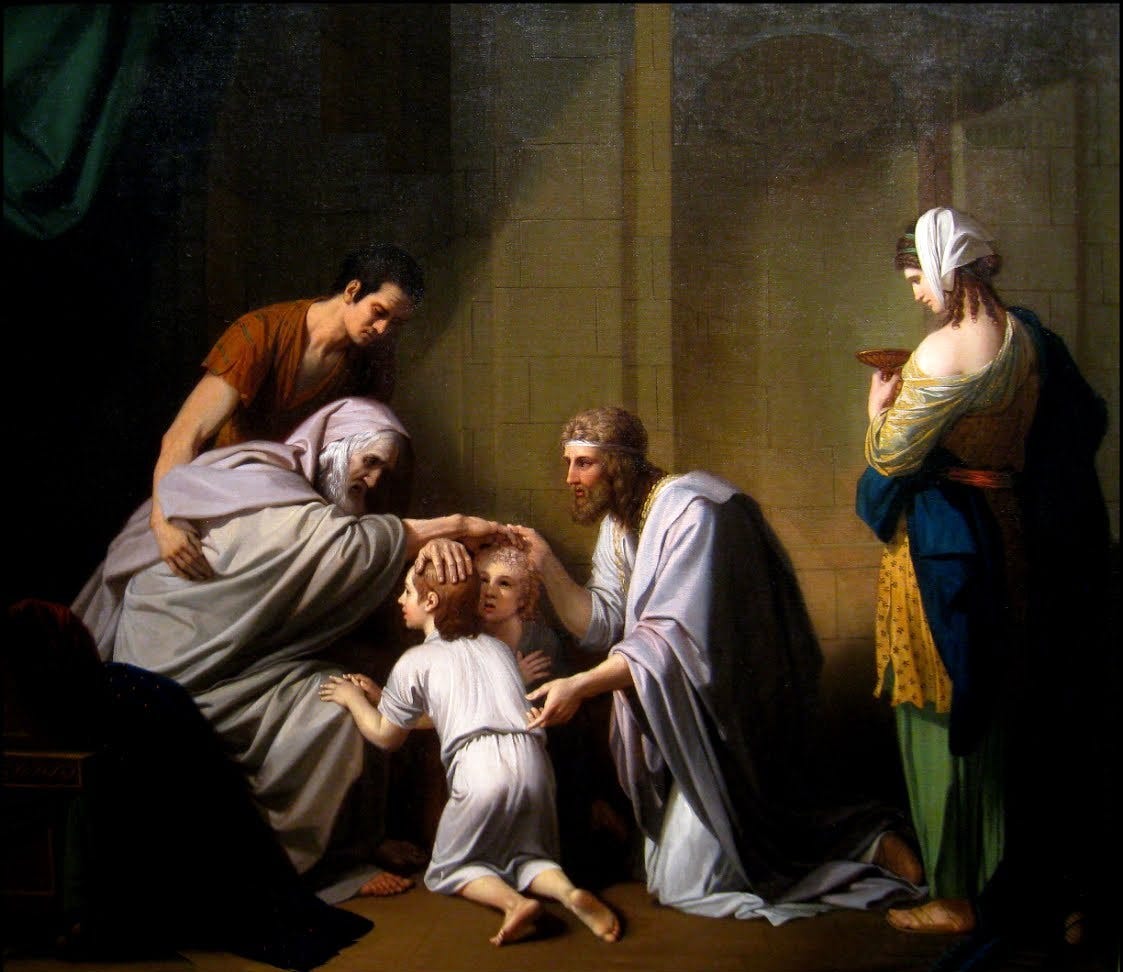
Salvation here has the basic motifs of “going into a kingdom, as a citizen,” and “inheriting, as a son” which is inherently a familial reception. And Jesus lays hands on the babies, in the method of conferring the blessing of inheritance. See Jacob and Esau. See Ephraim and Manasseh.

Jacob Blessing Ephraim and Manasseh, Benjamin West, c. 1768
Jesus says the babies are kingdom members, which in context means owners of eternal life. Jesus shows it by his laying on of hands, as it were, ordaining them publicly to their inheritance. And Jesus marks it in the memories of the people who would preach the kingdom outward for him, his disciples, by chewing them out for getting in the way of his little rightful rulers, little princes and princesses come to see the throne-room without fear, because they belong in the family line of the King.
These two stories are tied together in all three synoptic gospels, so the analysis holds in all three places as well.
WELL MAYBE THEY WEREN’T REALLY BABIES?
That’s a good question. Maybe they were youngsters, and maybe their going to Jesus was a good enough sign of maturity, a sign that they understood? Forgive the straw man – this is a sincere and real question that I myself asked years ago when trying to know what to think about this passage. So it was not a straw man then. But here’s the answer. Luke 18 says explicitly, “Now they were bringing even infants to him that he might touch them,” (Luke 18.15).
As if “infant” or “nursing babe” isn’t strong enough, it is intensified by “even.” These people were coming to be touched. They were bringing children to him also, they were also at the bottom rung, “even” bringing him infants.
In every case, these children are said to be brought to Jesus. And since we know that some are even infants, we cannot take, “let the children COME to me” as a statement requiring the children to be walking, self-examining children.
WELL MAYBE THAT’S JUST THE STATE OF ALL BABIES?
If you were an Israelite, used to the Psalms, you would assume that children born to the covenant would be able to say “from my mother’s womb you have been my God,” at the same time as saying that such a relationship was from faith: “you made me trust you at my mother’s breasts,” (Ps 22.9-10).
But you would also be familiar with David’s other claim, that babies are sinners from the womb. Even saved babies are sinners from the womb: “Behold, I was brought forth in iniquity, and in sin did my mother conceive me,” (Ps 51.5), a reference to David’s own sinful state, not that of his mother, (See Ps 51.3-6). David says in Psalm 22 that he was filled with faith, and in Psalm 51, he says he was naturally a sinner. And both are true from the womb. If a believer is naturally a sinner, then how much more a non-believer.
What about the wicked? David says in Psalm 58.3: “The wicked are estranged from the womb; they go astray from birth, speaking lies.” Psalm 58 is written in a chiasma The chiastic pair for the above verse is: “Let…[the wicked]…be like the stillborn child….” Their spiritual state is said to be like a dead child, and they are said to have come forth estranged and in iniquity.
SO IF THE KINGDOM BELONGS TO SOME
It doesn’t apply to all. But the audience hearing and bringing to Jesus were themselves believers. And because of that Jesus accepts their children.
HOW COULD SINNERS BE SAVED?
We have already heard that even believing infants are sinners. But we have also heard the believing infant in Israel is confessionally expected to have a resting and reclining hope and trust in their God. Between the Psalms 51, and 58, and 22, and 71, we have a very normal picture that all people are sinners, and that God will save those who trust him. The Psalmist says these infants have a kind of faith. Of course, otherwise, the kingdom could not belong to them.
All people are sinners, and through one man’s sin condemnation went to all people (Romans 5.18). And we are told that salvation must be granted through faith. (Eph 2.8, Heb 11.6) Then, since these babies own the kingdom, and have entered into life, and are heirs of eternal life, and have been saved, then they too must have some kind of faith. But that is simple to expect, because their kind of faith is not far off, and it is not too hard, and it is the model kind of faith. The kind of faith that trusts and leans. The kind of faith that teaches disciples how to be in God’s presence: by trusting. In fact, the babies were the true cherubim, the gatekeepers watching out lest false disciples enter in!
So we know that it is normal to expect children in the church to have access to the kingdom, and the Psalms we confess tell us how – by God’s supernatural work of giving trust in the womb, a work which takes those conceived in sin, and says they will be God’s from the womb, and will not be astray. They are saved from sin, and no one is saved without some kinda faith or a nuther.
MOSES AND GOD’S WRATH
Oh, I did say to remind me about Moses, didn’t I? Very good. This fits in so well to the whole discussion, because it relates to our expectation of what God wants from us about our children, and it relates to circumcision, and therefore to baptism.
Well do you remember the story? Moses was on his way…OH, Look at the time! I guess we’ll have to just take this up next time you drop by.

Jesus trusted God as a baby once, too!
Nativity, Georges de la Tour
—
Luke Welch has a master’s degree from Covenant Seminary and preaches regularly in a conservative Anglican church in Maryland. He blogs about Bible structure at SUBTEXT. Follow him on Twitter: @lukeawelch<>game rpg onlineinternet speed test yandex
A chiasm is a reflection. That means the parts of the Psalm are written in pairs that match from beginning to end, like this: A, B, C, D, D, C, B, A. (back)
A chiasm is a reflection. That means the parts of the Psalm are written in pairs that match from beginning to end, like this: A, B, C, D, D, C, B, A.
The post Paedocommunion? Saved by Some Kinda Faith or a Nuther appeared first on Kuyperian Commentary.